A history of growing food in space
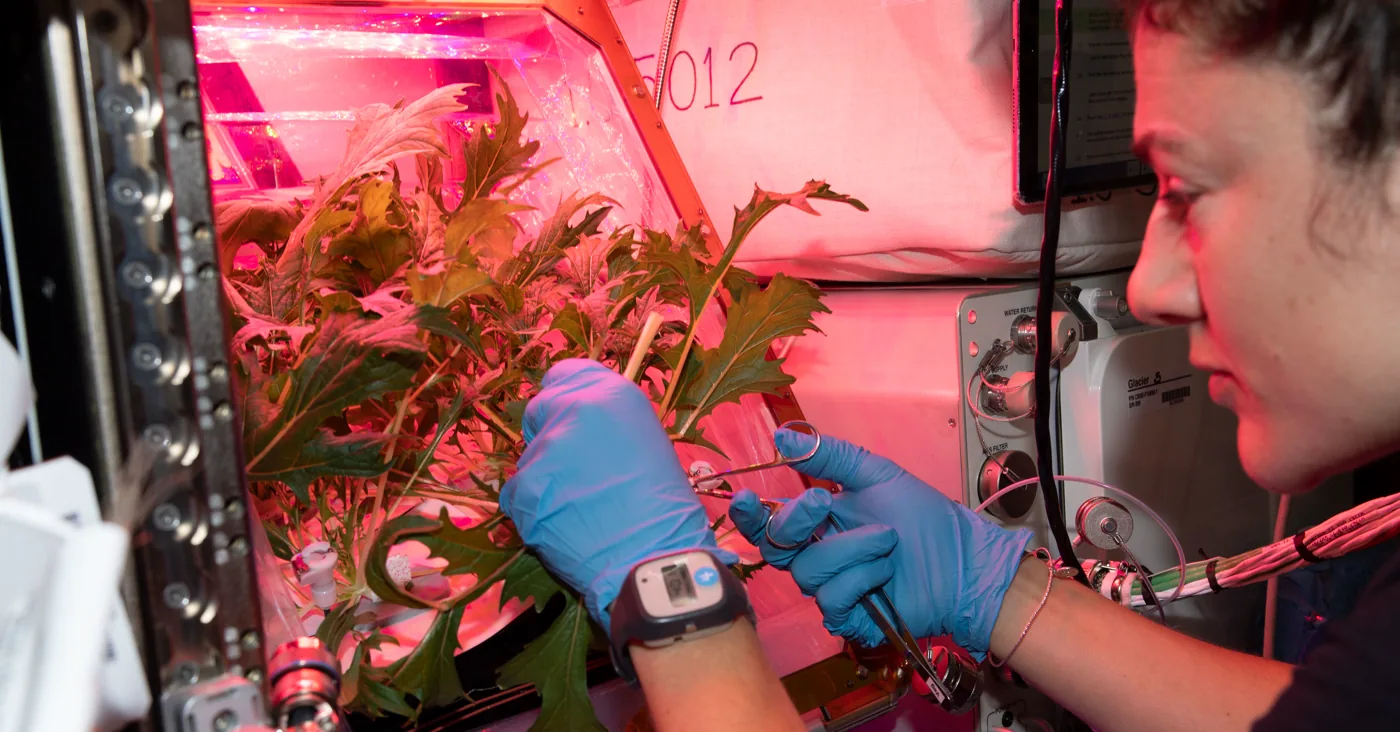
The history of growing food in space is much longer than the history of eating it.
On 10 August 2015 a crop of red romaine lettuce was harvested aboard the International Space Station and eaten live on NASA TV.
It is usually called the first crop grown and eaten in space. Long before we were growing plants in space we were looking for them on other planets, which we covered in our post Astrobotany and the hunt for the VRE — a century of searching that has turned up no evidence of off-world plants.
Trying to Grow Plants in Space
That turned out to be a shorter list than you would expect.
45 hours, 75 wheat seedlings
Thirteen experiments went to low Earth orbit. NASA’s release calls Charles Lyon’s seedlings “the first plants ever grown in weightlessness”. Their roots curved upward.
They also grew as much in 45 hours as their ground twins did in three days, which nobody has entirely explained since.
The cycle closes
The first complete plant life cycle in spaceflight: Arabidopsis thaliana germinated, flowered and set seed without ever touching gravity, as reported by Merkys and Laurinavičius. Forty-two per cent of the seed was biologically valuable.
A useful failure
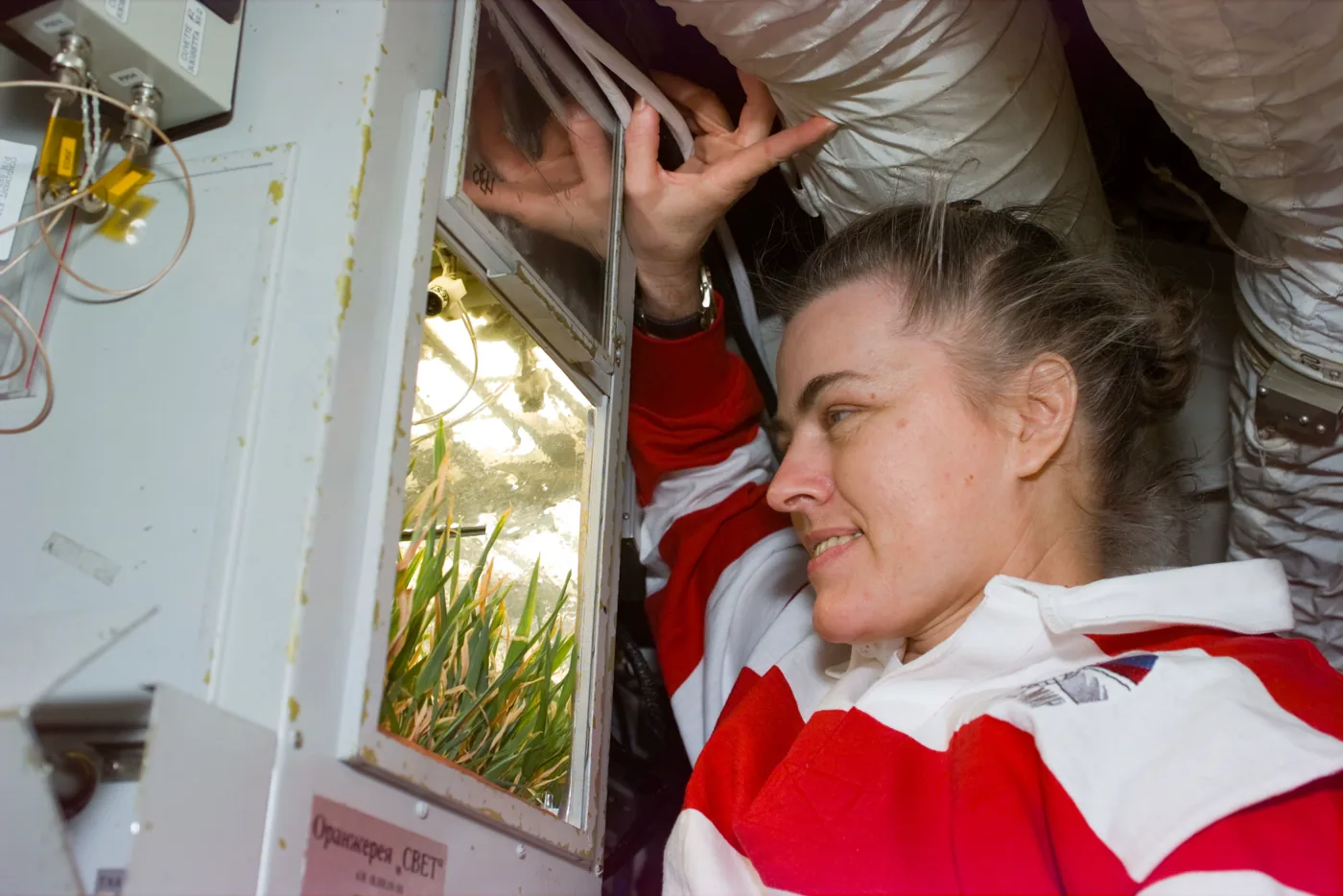
Shannon Lucid at Mir's Svet greenhouse, 23 September 1996 — a later wheat run in the neighbouring facility, not the 1994 experiment on this row. NASA STS079-E-5277, public domain. The super-dwarf wheat experiment ran 167 days. Growth halted around day 40 and resumed at day 100. Three heads appeared, one was sterile, and 28 seeds matured — on Earth, after return.
The second closure, by hand
Brassica rapa (mustard) completed full life cycles across three experiments, with a cosmonaut hand-pollinating the flowers.
The resulting seeds held under 20% of the cotyledon cells of ground controls, and stored starch where they should have stored protein and lipid. That result cuts twice: what the seed is worth eating, and whether it becomes the next crop.
Musgrave’s conclusion is the honest one: gravity is not required for any step of the life cycle, and seed quality is compromised anyway.
No year on this row, deliberately. The abstract gives “a 122-d opportunity” and no calendar dates; the run is usually attributed to the 1997 Mir-NASA-5 increment, and that attribution appears nowhere in the paper.
Two generations
Link and colleagues grew Arabidopsis seed to seed aboard the ISS, then sowed that orbit-grown seed and did it again — a second generation that had never known gravity in its own life or its parent’s.
This seed held up where Musgrave’s had not: 92% germination, and protein bodies 55% smaller than controls but only 9% down on measured protein content. The conclusion is narrower than it first reads — gravity is not necessary for seed-to-seed growth, but it shapes plant form and may influence what a seed stores.
Somebody eats it
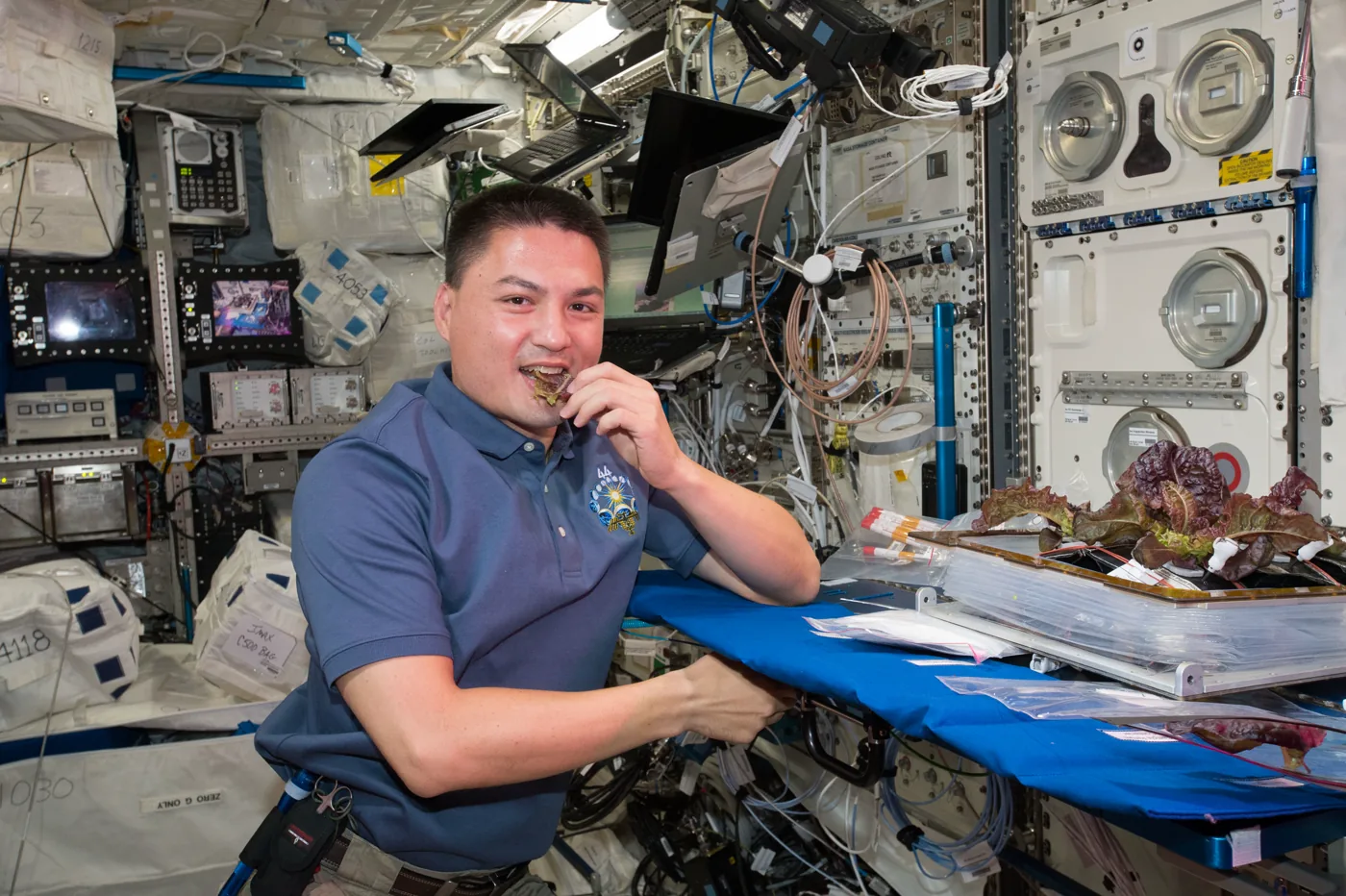
Kjell Lindgren eating the harvest at the Maintenance Work Area. NASA iss044e045824, public domain. Every row above this one is botany: the plant was the experiment, not the meal. Veggie’s ‘Outredgeous’ red romaine was harvested, half kept for science and half for lunch.
The first run, in 2014, was grown, harvested, frozen and flown home whole so a laboratory could count what lived on it — leaf, root, water, media, wick. No pathogens, and a bacterial load inside the limits for non-thermostabilised food. The deliverable was a clearance, not a salad.
The 2015 crop cleared the same bar, but not identically. Khodadad and colleagues later found its leaves carrying aerobic bacterial counts orders of magnitude above their ground control — the only planting of three that did — while E. coli, Salmonella and S. aureus stayed absent and the count itself, 4.86 log₁₀ CFU/g, sat below supermarket lettuce.
Nutritionally, orbit changed nothing: no flight crop differed significantly from its own ground control in elemental content. The spread was between plantings — this one higher in sodium, phosphorus, sulphur and zinc, the 2016 run lowest in iron, potassium and phenolics, anthocyanins and antioxidant capacity flat throughout. The authors decline to explain it, floating a year’s drift in the station’s water supply and hedging immediately: the changes are real, they matter for a long mission, and they need better experiments than three plantings grown eighteen months apart.
The ground analogue gets serious
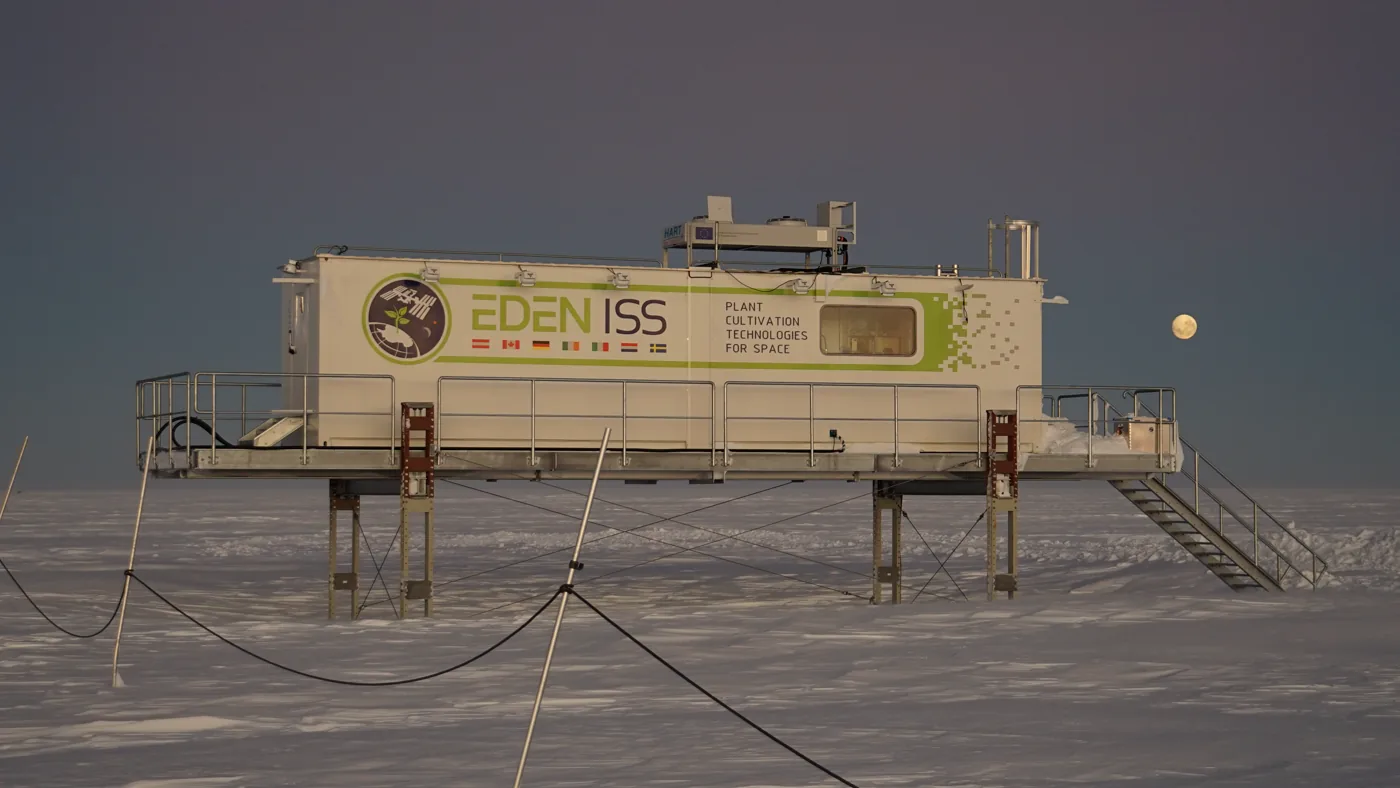
The EDEN ISS greenhouse on the Ekström Ice Shelf, 31 May 2018. DLR, CC BY 2.0, via Wikimedia Commons. Two shipping containers 400 m from Neumayer Station III ran for 286 days and produced over 268 kg of edible biomass from 12.5 m² — cucumbers 67 kg, lettuces 56 kg, tomatoes 50 kg. Ten people ate most of it through a polar winter. That is still the yield to beat.
The one with nobody aboard
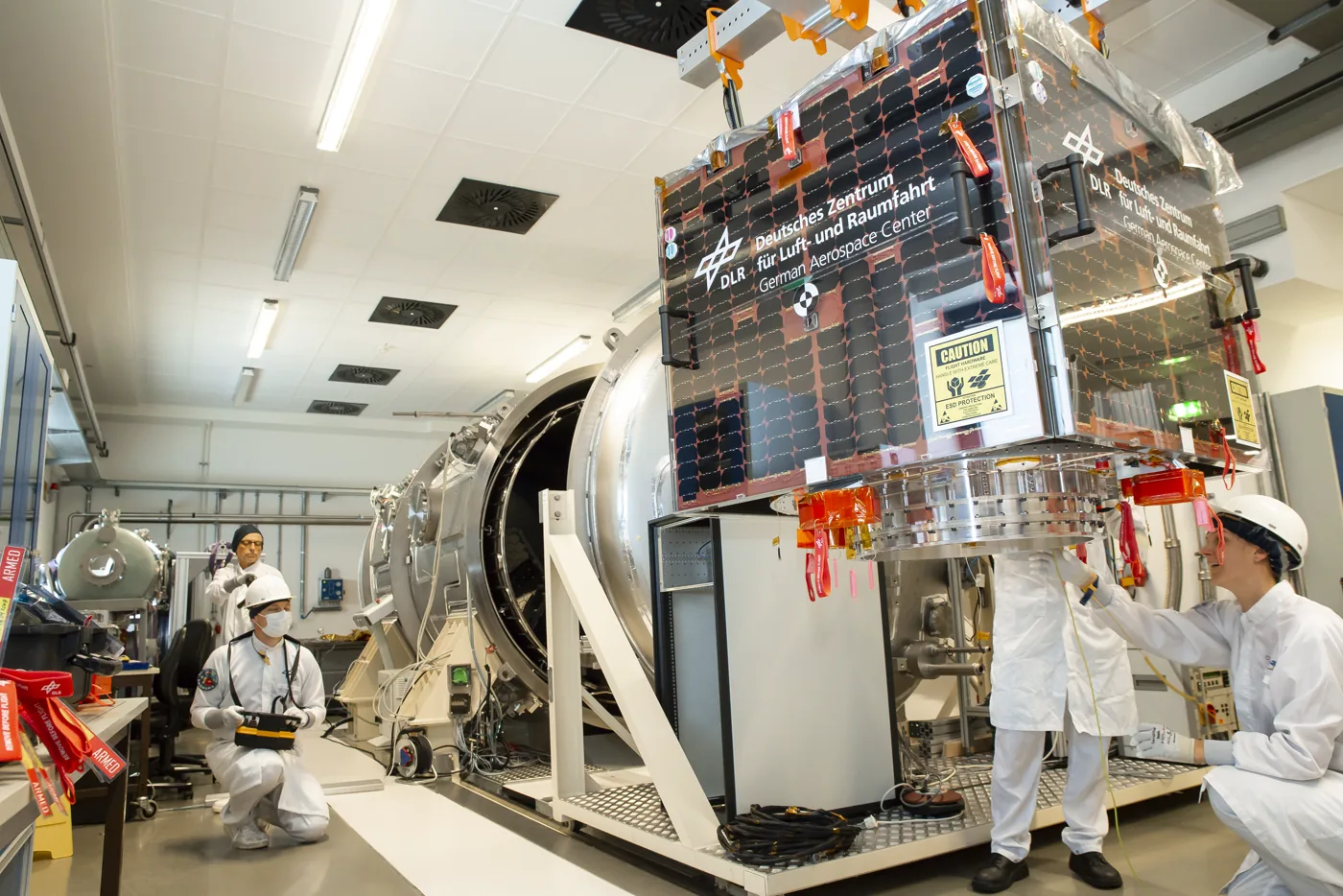
Eu:CROPIS at thermal test in Bremen, 6 August 2018, four months before launch. DLR, CC BY 3.0 DE, via Wikimedia Commons. DLR launched two greenhouses on a spinning free-flyer, meant to grow dwarf tomatoes at lunar and Martian gravity with no crew anywhere near them. In January 2019 a routine software update put both greenhouses into safe mode. Eleven months of ground recovery attempts failed. DLR’s own account is precise and devastating: the greenhouses “are still functional, but … irrigation cannot be initiated”.
Nothing germinated. As of DLR’s last word on the mission, the seeds are still up there, dormant.
The crop that came back different
Two mizuna runs, 6 June–11 July and 3 October–30 November, grown against ground controls and analysed leaf by leaf. Where the lettuce had matched its controls, the mizuna did not. Sulphur came out higher in the flight plants in both runs, and in the longer of the two so did magnesium, potassium, sodium and iron — flight-versus-ground effects, in the authors’ reading, “likely more pronounced in the longer experiment”.
The harvest protocol moved the numbers as much as orbit did. The single-harvest run gave more iron and phenolics; the two-month cut-and-come-again run gave more magnesium, manganese and calcium. Nutrients trade against each other, which makes the growing protocol a dietary decision rather than a horticultural one. The crew preferred the flight-grown leaves to the ground-grown ones regardless.
Better plumbing, same crew
Veggie waters by wicking, which has never reliably worked — most runs fell back to an astronaut with a syringe. The Advanced Plant Habitat replaced the wick with porous tubes through the substrate, and the difference shows: radish reached an edible hypocotyl in 27 days on orbit across two grow-outs in November and December 2020, and the crew ate them. Chile peppers followed from July 2021 — self-pollinating, pick-and-eat, picked partly for vitamin C.
This is the closest the record comes to a chamber that runs itself, and it is worth being exact about how close. NASA describes APH as largely automated. The radish paper does not enumerate which steps were automated and which were hand- executed, so it cannot settle that framing either way. What it establishes is narrower and still useful: the watering worked.
Growing Plants Autonomously
This is where it gets interesting for Artera, because we want the plants to precede the humans — growing, harvesting and stocking shelf-stabilised food before anyone arrives at the destination.
Nothing above does that. Every crop success on this list had a human in the room: Merkys’ Arabidopsis, Musgrave’s hand-pollinated Brassica, Veggie’s lettuce, EDEN ISS through a polar winter. The single serious attempt at an uncrewed free-flying greenhouse was killed inside two months by a deployment, and the hardware was never broken. The command path was.
References
- “Plant and animal life safely recovered from Biosatellite II”, NASA Headquarters news release 67-239, 14 September 1967. NTRS 19670029987
- Merkys, Laurinavičius & Švegždiene, “Plant growth, development and embryogenesis during Salyut-7 flight”, Adv. Space Res. 4(10):55–63, 1984. doi:10.1016/0273-1177(84)90224-2
- Mashinsky, Ivanova, Derendyaeva, Nechitailo & Salisbury, “From seed-to-seed experiment with wheat plants under space-flight conditions”, Adv. Space Res. 14(11):13–19, 1994. doi:10.1016/0273-1177(94)90274-7
- Musgrave et al., “Gravity independence of seed-to-seed cycling in Brassica rapa”, Planta 210(3):400–406, 2000. doi:10.1007/PL00008148
- Link, Busse & Stankovic, “Seed-to-Seed-to-Seed Growth and Development of Arabidopsis in Microgravity”, Astrobiology 14(10):866–875, 2014. doi:10.1089/ast.2014.1184
- Massa, Hummerick, Spencer & Smith, “Veggie ISS Validation Test Results and Produce Consumption”, NASA Kennedy Space Center, 2015. NTRS 20150021302
- Khodadad, Hummerick, Spencer, Dixit, Richards, Romeyn, Smith, Wheeler & Massa, “Microbiological and Nutritional Analysis of Lettuce Crops Grown on the International Space Station”, Frontiers in Plant Science 11:199, 2020. doi:10.3389/fpls.2020.00199
- Zabel, Zeidler, Vrakking, Dorn & Schubert, “Biomass Production of the EDEN ISS Space Greenhouse in Antarctica During the 2018 Experiment Phase”, Frontiers in Plant Science 11:656, 2020. doi:10.3389/fpls.2020.00656
- Bunchek, Hummerick, Spencer, Romeyn, Young, Morrow, Mitchell, Douglas, Wheeler & Massa, “Pick-and-eat space crop production flight testing on the International Space Station”, Journal of Plant Interactions 19, 2024. doi:10.1080/17429145.2023.2292220
- John, Abou-Issa & Hasenstein, “Space Flight Cultivation for Radish (Raphanus sativus) in the Advanced Plant Habitat”, Gravitational and Space Research 9(1):121–132, 2021. doi:10.2478/gsr-2021-0010
- “Plant Habitat-04: Growing Peppers in Space”, NASA, June 2021. nasa.gov
- “Farewell to the Eu:CROPIS mission”, DLR, 13 January 2020. dlr.de